Open letter, March 2021: Professor Alison Bashford – Please reconsider the Dan David Prize

This open letter to Professor Alison Bashford (UNSW) was coordinated by members of Sydney Staff for BDS in collaboration with other Palestine supporters in Australian universities. The letter was originally available for signature here.

Dear Professor Bashford,

We are academics, researchers and students. We ask you to please reconsider accepting your share of the prestigious 2021 Dan David Prize,[1] the academic award administered by and headquartered at Tel Aviv University (TAU).[2] This year’s prize rewards scholars who have contributed to advances in and understanding of medicine and public health. In reality, however, accepting it serves to legitimize and normalize Israel’s colonial violence and apartheid.

As we are sure you are aware, for decades, through its military occupation, blockade and apartheid, Israel has been undermining Palestine’s health systems and systematically denying Palestinians medical care.[3] In a report from November last year, the director of the World Health Organisation noted that Israel’s ‘chronic occupation has profound implications for the sustainability of health-care provision by public authorities, in terms of both revenue raising and affordability.’[4] Palestinians are regularly blackmailed into collaboration with the Israeli Security Services in order to get the permits they need to leave the West Bank and Gaza for medical treatment.[5] Currently, while Israel has been hailed for vaccinating its population, it is refusing to immunize all Palestinians under its rule,[6] as is its responsibility,[7] and placing obstacles in the way of transfer of vaccines into Gaza and the West Bank, entry to which it fully controls – clear testament to the apartheid regime it maintains.[8]

Since 2005, Palestinian civil society organizations have been calling on supporters of justice and antiracism around the world to express solidarity with the Palestinian people and the Palestinian cause by boycotting Israel, including its academic institutions. Accepting the prize would be a clear violation of this call, and an outright refusal of Palestinians’ aspirations for freedom. We ask you to respect the wishes of Palestinian people and not side with their oppressor.

TAU directly facilitates Israel’s ongoing illegal occupation of the West Bank and its illegal blockade of Gaza. It must be held accountable for supporting Israel’s repression of Palestinians. Examples of TAU’s complicity in Israel’s anti-Palestinianism are numerous:

  • An affiliate of the university’s Sackler School of Medicine, the Abu Kabir Forensic Institute,[9] is currently stockpiling the bodies of scores of Palestinians for use as leverage in negotiations, refusing to release them to their families, a practice which contravenes international treaties and conventions.[10]
  • TAU hosts the Institute for National Security Studies, whose 2018 ‘Plan’ recommends completing the illegal separation wall, and ‘ongoing construction in settlement blocs’ – in other words, perpetuation of Israeli apartheid – and which declares in its current report that ‘it is necessary to prepare for the next war’.[11]
  • TAU’s Yuval Ne’eman Workshop for Science, Technology and Security cooperates closely with the Israeli Defence Force and other security services, and hosts work on, among other things, ‘missiles and guided weapons, homeland security, [and] force build-up policy’.[12] In 2008 the TAU President described himself as ‘awed by the magnitude and scientific creativity of the work being done behind the scenes at TAU that enhances the country’s civilian defense capabilities and military edge’.[13]
  • TAU’s Iby and Aladar Fleischman Faculty of Engineering runs an ‘entrepreneurship program’ with Elbit Systems,[14] a major Israeli arms manufacturer, whose weapons and technology are battle-tested on Palestinians.[15]
  • Since 2016, as at all Israeli universities, soldiers’ TAU tuition fees are paid after discharge from the army.[16]
  • In 2014, TAU offered a year’s free tuition to students who had participated in the murderous military attacks on Gaza.[17]
  • In 2012, TAU started collaboration with settlement organisations in archaeological digs in Palestinian East Jerusalem, in violation of international agreements.[18]

Professor Bashford, we call on you to follow the lead of your colleague and fellow historian Professor Catherine Hall, who in 2016 refused the Dan David Prize prize.[19] Doing so would make an important contribution to the cause of antiracism and opposition to apartheid in Israel in a context in which state-led resolution efforts have failed. It would also avoid a flagrant contradiction with your own published work, which aims to contribute to ‘the critical history of colonialism, nationalism and public health’, investigating, among other topics, ‘segregation as both hygienic – that is, as part of public health – and racial – as part of the systems and cultures of race management’.[20]

Israel’s racist policies against Palestinians, long criticised as instances of apartheid by Palestinians themselves, as well as by international legal and humanitarian authorities (including recently by the Israeli NGO B’Tselem) are an egregious example of racial segregation imposed on an entire population, with all the desperate consequences for Palestinians’ health and well-being that this implies.[21]

Professor Bashford, you have a significant opportunity to contribute to public understanding of the importance of antiracism and anti-apartheid. In 2003, you and a co-author noted that ‘even repressive regimes have been eroded through criticism generated by external human rights groups attempting to universalise democratic ideals’; as you pointed out, ‘it is difficult to imagine the dismantling of apartheid in South Africa, for example, without the chorus of international calls to release high-profile political prisoners on Robben Island’.[22] Palestinians’ appeal for boycott is an attempt to mobilise a chorus of international calls of exactly this kind.

Nothing obliges you to accept the Dan David prize and the financial reward that accompanies it. Doing so would be a sharp rebuke to the unanimous call from Palestinian organisations to support their struggle for freedom. As you have noted, ‘liberalism and the idea of democratic rule — most recently through the language of human rights — problematises arbitrary detention, the incarceration of non-criminals and of political prisoners’.[23] These are, however, among the very practices which Israel imposes on Palestinians. Refusing the award, opposing the whitewashing of Israel’s crimes, and rejecting collaboration with an Israeli academic institution complicit with the oppression of Palestinians, would earn you the respect and admiration of all those who believe that academic research must serve the cause of freedom, in Palestine and in the world.

Samah Sabawi, independent scholar, Melbourne
Nick Riemer, University of Sydney
Rima Najjar, Al Quds University, Palestine
Ahmed Alnajjar. Director of Public and International Relations, Ministry of Education, Palestine
Randa Abdel-Fattah, Macquarie University
Randa Farah, University of Western Ontario
Wael Hallaq, Columbia University
Laleh Khalili, Queen Mary University of London
Lila Abu-Lughod, Columbia University
Rashid Khalidi, Columbia University
Nadia Abu El-Haj, Columbia University
Saree Makdisi, UCLA
Judith Butler, UC Berkeley
Ilan Pappe, University of Exeter
Omar Barghouti, independent scholar
J. Kehaulani Kauanui, Wesleyan University
Jasbir Puar, Rutgers University
Peter Slezak, University of New South Wales
John Keane, University of Sydney
Alistair Sisson, University of New South Wales
Michael Grewcock, University of New South Wales
Alana Lentin, University of Western Sydney
David Brophy, University of Sydney
James Godfrey, Birkbeck, University of London
Jumana Bayeh, Macquarie University
Adi Ophir, Tel Aviv University, Emeritus, Brown University, visiting
Sara Dehm, University of Technology, Sydney
Ntina Tzouvala, Australian National University
Lucia Sorbera, University of Sydney
Kieron Cadey, Canterbury Christ Church
Inna Michaeli, independent scholar, Germany
Michael Griffiths, University of Wollongong
Sara Saleh, University of New South Wales
Liyana Kayali, Australian National University
Micaela Sahhar, University of Melbourne
Kate Davison, University of Melbourne
Daniel A. Segal, Pitzer College of the Claremont Colleges, USA
Nicola Perugini, University of Edinburgh
Sharri Plonski, Queen Mary, University of London
Ronit Lentin, Trinity College Dublin
Ryan Al-Natour, Charles Sturt University
Robert Boyce, London School of Economics
Mohd Nazari bin Ismail, University of Malaya
Lobna Yassine, Australian Catholic University
Suzita Noor, University of Malaya
Karel Arnaut, KU Leuven
Paola Manduca, University of Genoa, Italy
John King, New York University
Angelo Baracca, University of Florence
Zati Azizul, University of Malaya
Marcelo Svirsky University of Wollongong
Elsa Haniffah Mejia Mohamed, University Malaya
MY Musa, USM
Aneesa Abdul Rashid, Islamic Medical Association of Malaysia
Herman De Ley, Ghent University
Bruce Robbins, Columbia University
Brinkley Messick, Columbia University
Gil Hochberg, Columbia University
Samera Esmeir, UC Berkeley
Mark Ayyash, Mount Royal University, Canada
Raja Jamilah Raja Yuso, University of Malaya
Norhayati Ab.Rahman, University of Malaya
Brian Boyd, Columbia University
David Faber, Flinders University
Noor Fadiya Mohd Noor, University of Malaya
Noor Adwa Sulaiman University of Malaya
Fatiha Shabaruddin, Universiti Malaya
Marc De Meyere Gent University
Susan Ferguson, Wilfrid Laurier University
Nozomi Takahashi, Staff scientist, VIB/Ghent University
Snehal Shingavi, University of Texas, Austin
Hassan Basri, University of Sultan Zainal Abidin
J. Ahmad, Universiti Teknologi MARA, Malaysia
Meera Atkinson, University of Notre Dame Australia
George H Morgan, Western Sydney University
Brian Brophy, University of Adelaide
Zul’aini Zainal Abidin, Kolej Poly-Tech MARA
Sharmani Patricia Gabriel, Universiti Malaya
Amir Nor, Islamic Science University
Omar bin Yaakob, Universiti Teknologi Malaysia
Mike Cushman, London School of Economics
Harry Smaller, York University, Canada
M.Tashid, University of Technology Malaysia
Rozaini Roslan, UTHM
Mohamed Hatta Shaharom, Chairman Ikram Foundation of Malaysia
Harlina Halizah Siraj, Universiti Kebangsaan Malaysia (UKM)
Prof Dr Hayati, USIM
Borhanuddin Mohd Ali, Universiti Putra Malaysia
Azman Che Mat, UiTM
Mustafa Mohd Hanefah, Universiti Sains Islam Malaysia
Ramli Bin Nazir, Universiti Teknologi Malaysia
Ahmad Hariza Hashim, Universiti Putra Malaysia
Prof Dr Norhasmah, UPM
Nor Azan, Universiti Kebangsaan Malaysia
Abdul Rashid Mohamed, Universiti Sains Malaysia
Daing Nasir Ibrahim University Malaysia Pahang
Sahrim Ahmad, UKM, Malaysia
Haiyun Ma, Frostburg State University, USA
Mahamod Ismail, Universiti Kebangsaan Malaysia
Tengku Shahrom Tengku Shahdan, Universiti Selangor
Suhaimi Mhd Sarif, International Islamic University Malaysia
A’zzah, CEO, Al Musab Institute
Wan Jefrey Basirun University Malaya
Adlina SuleimanAcademy of Professors Malaysia
Khairul Saidah Abas Azmi, University of Malaya
Noorsyazly Rameli, Malaysia
Mohammad Nazri, Universiti Malaya
Kelton Muir Sydney University
John Michael O’Brien, University of Sydney
Souheir Edelbi, UNSW
Paul Russell, Victoria University
Toby Fitch, University of Sydney
Finola Laughren, University of Sydney
Azmi Aminuddin, UiTM
Rohana Hassan, UiTM
Christiane Schomblond, Université Libre de Bruxelles
Kathryn Ticehurst, University of Sydney
Carol Que, University of Melbourne
Noor Sapiei, University of Malaya
Alan Hill, RMIT University, Melbourne
Goldie Osuri, University of Warwick
Azman Hassan, Universiti Teknologi Malaysia
Meloni Muir, University of Sydney
Liam Ward, RMIT University, Melbourne
David Klein, California State University Northridge
Vannina Sztainbok, University of Toronto
Colin Mooers, Ryerson University, Canada
Sylvat Aziz, Queens University, Toronto
Joy Moore, Dawson College, Montreal
Asha Varadharajan, Queen’s University
Brett Story, Ryerson University
Larry Hannant, University of Victoria
Sumi Hasegawa, McGill University
Nicola Pratt, University of Warwick
David Borgonjon, Rhode Island School of Design
Kevin Moloney, York University, Toronto
Steven Jordan, McGill University
Tim Anderson, Centre for Counterhegemonic Studies
Peter Chidiac, University of Western Ontario
Anne Meneley, Trent University
Edwin E. Daniel, University of Alberta
Christo El Morr, York University
Natalia Maystorovich Chulio, University of Sydney
Matilda Fay, University of Technology Sydney
Mark LeVine, UC Irvine
Robert Austin, University of Sydney
Viviana Ramírez, independent scholar, Chile
Mohd Hilmi Jaafar, University of Malaya
Victor Wallis, Berklee College of Music
Zuhaimy ismail, Universiti Teknologi Malaysia
Shira Robinson, George Washington University
Daing Nasir Ibrahim, University Malaysia Pahang
Malek Abisaab, McGill University
Graham Holton, University of Queensland
Ben Golder, University of New South Wales
Izlin Ismail, University of Malaya
Suzannah Henty, University of Melbourne
Shamsul Izwan bin Saharani, University of Malaya
Yara Hawari, University of Exeter
Nate George, Columbia University
Jake Lynch, University of Sydney
Michael Leonard Furtado, University of Queensland
Lewis Turner, Newcastle University
Owen Marsden-Readford, Sydney University SRC
Sonia Qadir, University of New South Wales
Susan Spronk, University of Ottawa
David Heap University of Western Ontario
Ximena de la Barra, lecturer and writer, Spain
Lim Yat Yuen, Universiti Malaya
Briony Neilson, University of Sydney
Didier Samain, Sorbonne Université, Paris.
Mohd Rais Mustafa, Universiti Malaya
UNSW Students for Palestine club, UNSW
Lauren Banko, University of Manchester
Evan Jones, Sydney University
Sujatha Fernandes, University of Sydney
Raja Hisyamudin, Senior Lecturer University of Malaya
Ben Etherington, Western Sydney University
Nurhazwani Abdul Rahman, Assistant Bursar, University of Malaya
David Pritchard, The University of Queensland
Judith Grbich, Griffith University
Eshah AWahab, University of Malaya
Muhammad Shamil, Pondicherry University
Roza Hazli Zakaria, University of Malaya
Sharmila Jayasingam, Universiti Malaya
Paola Rivetti, Dublin City University
Kevin Bruyneel, Babson College
Marc Lamont Hill, Temple University
Michelle Hartman, McGill University
Stephen Sheehi, William & Mary
Ariella Azoulay, Brown University
Haim Bresheeth-Zabner SOAS, University of London
Sarah Schulman, City University of New York, College of Staten Island
Sherene Seikaly, UCSB
Peter Eglin, Wilfrid Laurier University
Andrew Brooks, UNSW
Holly High, University of Sydney
Valentina Baú, University of New South Wales
Noam Peleg, UNSW
Safiah Muhammad Yusoff, University Malaya
Jonathan Dunk, University of Melbourne
Mohamad Said Bin Othman, University Of Malaya
Joseph Pugliese, Macquarie University
Andy Kaladelfos, UNSW
Matthew Abbott, Federation University
Claire Launchbury, Leeds
Meaghan Morris, University of Sydney
Anna Hush, University of New South Wales
Aurelien Mondon, University of Bath
Helen Goritsas, Academy of Information Technology, Australia
Judith Mcvey, University of Sydney
Amy Thomas, University of Technology Sydney
Diana Shahinyan, University of Sydney
Marcus Banks, RMIT University, Melbourne
Tasnim Sammak, Monash University
Lina Koleilat , Australian National University
Catriona Menzies-Pike, Western Sydney University
Jordy Silverstein, La Trobe University
Iseult Mc Nulty, Trinity College Dublin
Maayan Geva, University of Roehampton
Cynthia Wright, York University
Ilan Kapoor, York University
Maya Ober, FHNW Academy of Art and Design, Switzerland
Michael Mohammed Ahmad, Western Sydney University
Najib Safieddine, University of Toronto
Diana Jefferies, Western Sydney University
Ned Curthoys, The University of Western Australia
John Docker, University of Sydney
Sophie Loy-Wilson, University of Sydney
Jimmy Yan, University of Melbourne
Anna Saunders, Harvard Law School
Caitlin Biddolph, University of New South Wales
Shaira Vadasaria, University of Edinburgh
Emma Russell, La Trobe University
Scott Burchill, Deakin University
Tarik Cyril Amar, Koc University, Turkey
Samia Khatun, SOAS, University of London
Gavan Titley, Maynooth University, Ireland
Francesco Saverio Leopardi, Ca’ Foscari University of Venice
Laurence Davis, University College Cork
Ismail Patel, independent researcher, England
Mohamad Faithal Haji Hassan, University of Malaya
Effie Karageorgos, University of Newcastle, Australia
Dalia Abdelhady, Lund University, Sweden
Mod Faizul Sabri, University of Malaya
Roland Loh, Kingston University, UK
Hussain Mohd, University Malaya
Awangku Abdul Rahman, Islamic Science University of Malaysia
Khadijah Md Khalid, University of Malaya
Sarah Keenan, Birkbeck School of Law
Leah Price, Rutgers University
Saul Takahashi, Osaka Jogakuin University, Japan
Ben Silverstein, Australian National University
Terence Gomez, Universiti Malaya
Roshidah Hassan, Universiti Malaya
Maha Nassar, University of Arizona
Suria Zainuddin, University of Malaya
Dr Bedj Bedj Toufik, University of Malaya
NW Salman, University of Malaya
M Zaidi A Rahman, University of Malaya
Aishah Ahmad Fauzi, University Malaya
Rodiah Zawawi, University of Malaya
Aileen Moreton-Robinson, RMIT, Melbourne
Muhamad Ammar Remli, Islamic Science University of Malaysia
Ghazala Mir, University of Leeds
Judith E. Tucker, Georgetown University
Salwa Mohd Saleh, University College London
Yasmine Kherfi, London School of Economics and Political Science
Kamakshi Amar, London School of Economics
Zulqarnain Mohamed, Universiti of Malaya
Tg Muzaffar Tg Muda, Lancaster University
Roger Markwick, University of Newcastle, Australia
Shuaib Manjra, University of Cape Town
Zulqarnain Mohamed, University of Malaya
Usuf Chikte, University of Stellenbosch
Jasmine Duff, University of Wollongong
Fairuz Mullagee, University of the Western Cape
Abu Bakar, University of Indonesia
Catherine Ann Cullen, Trinity College Dublin
WZ Kamaruddin Ali, University of Malaya
Prof. Dr. Mohd Afandi Salleh, Universiti Sultan Zainal Abidin, Malaysia
Yau’Mee Hayati Hj Mohamed Yusof, Universiti Teknologi MARA, Malaysia
Wan Muhammad Afiq bin Wan Muhamad Fauzan, INSPEM Universiti Putra Malaysia
Zulfakar Ramleem International Islamic University, Malaysia.
Tuti Iryani Mohd Daud, Universiti Kebangsaan, Malaysia
Sahrim Ahmad, Universiti Kebangsaan, Malaysia
Zul’aini Zainal Abidin, Kolej Poly-Tech MARA, Malaysia
Abdul Rashid bin Abdul Rahman, University of Cyberjaya, Malaysia
Hadhrami Ab Ghani,Universiti Malaysia Kelantan
Syamimi Saadon, Universiti Putra Malaysia
Alwani Ghazali, Universiti Malaya
Rohaida Mohd Saat, independent scholar, Malaysia
Siti Zarina Mohd Muji, Universiti Tun Hussein Onn, Malaysia
Ahmad Ainuddin Nuruddin, Universiti Putra, Malaysia
Nurul Iffah Bt Ghazali, UiTM Puncak Alam
Mandy Turner, University of Manchester
Dror Warschawski, Sorbonne Université, France
Ahmed Abbes, CNRS, France
Professor Hairuddin Mohd Ali, International Islamic University Malaysia
Nada Elia, Western Washington University, USA
Carolyn D’Cruz, La Trobe University
Siti Zaiton Mohd Hashim, Universiti Malaysia Kelantan
Priya Kunjan, University of Melbourne
Rabah Tahraoui, Université de Rouen, France.
Poppy de Souza, Griffith University and UNSW
Maree Pardy, Deakin University
Dr Crystal McKinnon, RMIT, Melbourne
Mohammed Massoud Morsi, Independent Scholar, Australia
Clive Gabay, Queen Mary University of London
Mahanim Hanid, Universiti Malaya, Malaysia
AbdulRahman Sufi, City University of Mogadishu, Somalia
Michael Harris, Columbia University
Zoë Lawlor , University of Limerick
James R. Levy, University of New South Wales Sydney
David Landy, Trinity College Dublin
Haim Bresheeth-Zabner, SOAS University of London
Professor Yosefa Loshitzky, SOAS University of London
Anam Matariyeh, Independent Scholar
Kenneth W. Burchell, Independent historian
Sarah Dweik, PSU
Waad Marzuqi, University of London
Lorenzo Ramero, Université de Lille
Zuhair Idris, Independent Scholar
Nour Ali, Brunel University
Erik Karlström, Lund University (masters student)
Abdulrachman Teves UPLB
Adel Yousif, University of Tasmania
C. Michael Hall, University of Canterbury
Ana Madeira, Universidade Nova de Lisboa
Anas Elkady, Ryerson University
Rachid Darradji, MIT
Shahd Al-Janabi, Charles Darwin University
Elaine Bradley, independent scholar, Ireland
Timothy Ström, independent scholar, Arena, Melbourne
Dan Tout, Federation University, Australia
Anitra Nelson, University of Melbourne
David Scrimgeour, University of Adelaide
Thalia Anthony, University of Technology, Sydney
Andres Ramirez, University of Melbourne

Notes
[1] https://newsroom.unsw.edu.au/news/general/unsw-sydney-historian-named-2021-dan-david-prize-laureate
[2] https://www.dandavidprize.org/about/about-the-prize
[3] A 2020 report by the WHO Director General, ‘Health conditions in the occupied Palestinian territory, including east Jerusalem, and in the occupied Syrian Golan’, for instance, finds that ‘Israeli settler population in the West Bank, estimated to comprise more than 600000 persons, compared to Palestinians living in the same territory, have a life expectancy almost nine years higher, infant mortality more than six times lower and maternal mortality nine times lower’, 12. https://apps.who.int/gb/ebwha/pdf_files/WHA73/A73_15-en.pdf
[4] ‘Health conditions in the occupied Palestinian territory, including east Jerusalem, and in the occupied Syrian Golan’, 18. https://apps.who.int/gb/ebwha/pdf_files/WHA73/A73_15-en.pdf
[5] https://www.theguardian.com/world/2011/dec/28/palestinians-gaza-strip-collaborate-israel
[6]https://reliefweb.int/report/occupied-palestinian-territory/joint-letter-free-and-equitable-access-and-distribution-covid
[7] https://www.ohchr.org/EN/NewsEvents/Pages/DisplayNews.aspx?NewsID=26655
[8] https://www.theguardian.com/world/2021/feb/16/israel-blocked-covid-vaccines-from-entering-gaza-say-palestinians
[9] https://www.health.gov.il/English/MinistryUnits/HealthDivision/MedicalAdministration/forensic/Pages/default.aspx
[10] https://www.aljazeera.com/news/2020/2/24/israel-slammed-for-necroviolence-on-bodies-of-palestinians
https://www.inss.org.il/publication/questions-answers-inss-plan-strategic-framework-israeli-palestinian-arena/;
[11] https://www.inss.org.il/publication/strategic-survey-the-operative-arena/
[12] https://en-sectech.tau.ac.il/about
[13] https://english.tau.ac.il/sites/default/files/media_server/TAU%20Review%202008-09.pdf
[14] https://en-engineering.tau.ac.il/Engineering-Faculty-Home-innobitenglish
[15] https://whoprofits.org/company/elbit-systems/
[16] https://www.israel365news.com/79016/first-time-idf-will-fully-fund-soldier-university-scholarships/
[17] https://electronicintifada.net/blogs/ali-abunimah/israeli-universities-lend-support-gaza-massacre
[18] https://www.haaretz.com/.premium-academics-urge-tel-aviv-u-not-to-join-e-j-lem-dig-1.5281799
[19] https://www.haaretz.com/israel-news/prominent-historian-rejects-israeli-academic-award-1.5386129
[20] Bashford A. (2004) Introduction: Lines of hygiene, boundaries of rule. In: Imperial Hygiene. Palgrave Macmillan, London, pp. 13 and 2.
[21] https://www.btselem.org/publications/fulltext/202101_this_is_apartheid
[22] Bashford A. and Strange C., ‘Isolation and exclusion in the modern world An introductory essay’, in Bashford A. and Strange C. (eds) Isolation: Places and Practices of Exclusion, London, Routledge, 2003, p.14
[23] Bashford A. and Strange C. ‘Isolation and exclusion in the modern world An introductory essay’, in Bashford A. and Strange C. (eds) Isolation: Places and Practices of Exclusion, London, Routledge, 2003, p.14

AFTER GAZA MASSACRE, ACADEMIC BOYCOTT OF ISRAEL SPREADS AT AUSTRALIAN UNIVERSITIES

Sydney University Staff for BDS, Wollongong University Staff for BDS Press Release

Thursday 16 May 2018, 9.40am

In the wake of Israel’s massacre of protesters in Gaza on Monday, the move to boycott Israeli academic institutions is gaining strength in Australian universities.

Last month, 37 staff at the University of Sydney made Australia’s largest ever public commitment to boycott Israeli academic institutions. That figure has now grown to 57. At the University of Wollongong, 32 members of staff have pledged to sever ties with Israeli academic institutions. The pledges follow the principles of the international boycott, divestment and sanctions (BDS) campaign, an international solidarity movement inspired by the success of boycotts in bringing an end to apartheid in South Africa.

While many academics in Australia have committed to the academic boycott, the 89 joint Sydney/Wollongong signatures represent the most serious public support for academic BDS ever seen in an Australian universities.

The signatories undertake to break all official contact with Israeli universities until Israel ends its occupation of UN-defined Palestinian land, grants full equality before the law to Palestinian citizens of Israel, and recognizes Palestinians’ right to return to the homes from which they were expelled in the 1948 war. Signatories will not attend conferences sponsored by Israeli universities, participate in academic exchange schemes, or otherwise collaborate professionally with Israeli universities until these goals have been fulfilled.

“When an oppressed people ask you to support them, you support them,” said Marcelo Svirsky from the “UOW Staff for BDS” group. “The Palestinian people in the West Bank and Gaza have been living under Israeli military occupation since 1967, an occupation that is becoming increasingly genocidal. Under present conditions Australian academics must make the right choice, which is supporting the Palestinian call to boycott Israeli official academic activities.”

“Academics increasingly acknowledge that the choices they make in their work can support a just peace in the Middle East,” said Nick Riemer from the ‘Sydney Staff for BDS’ group, which coordinated the pledge at Sydney University. “More and more colleagues are realising that Israel is the new South Africa. When apartheid against Palestinians has finally been lifted and democracy has come to Israel, academics want to be able to say they played their part.”

The pledge concludes by stating that signatories ‘look forward to a time when Israel is prepared to negotiate seriously and in good faith with Palestinians, and civil society actions like the boycott are no longer necessary’.

At both the University of Sydney and Wollongong, support for Palestine is strong among students, with active student support groups. 111 Palestinians have been killed and 13000 injured in the protests at the Gaza border fence since March 30. On Monday, the IDF killed 61 people, the youngest of whom was an 8-month old, Laila al-Ghandour, who died of tear gas inhalation.

Contact: Nick Riemer, University of Sydney, 0481 339 937, nick.riemer@sydney.edu.au; Marcelo Svirsky, University of Wollongong, 0437 890 005, msvirsky@uow.edu.au.

AFTER GAZA KILLINGS, ACADEMIC BOYCOTT OF ISRAEL TAKES OFF AT SYDNEY UNIVERSITY

Press Release – Thursday 12 April 2018 – For immediate release

AFTER GAZA KILLINGS, ACADEMIC BOYCOTT OF ISRAEL TAKES OFF AT SYDNEY UNIVERSITY

Israel’s recent killing of protesters in Gaza has led staff at the University of Sydney’s Faculty of Arts and Social Sciences to make Australia’s largest ever public commitment to boycott Israeli academic institutions.

With Palestinians in Gaza preparing for their third consecutive Friday of protest in support of their right to return to their homes, thirty seven academics in the Faculty of Arts and Social Sciences have publicly signed a pledge to break ties with Israeli academic institutions. The pledge follows the principles of the international boycott, divestment and sanctions (BDS) campaign, an international solidarity movement inspired by the success of boycotts in bringing an end to apartheid in South Africa.

While many academics in Australia have committed to the academic boycott, the thirty seven Sydney University signatures represent the most serious public support for academic BDS ever seen at an Australian university.

The signatories undertake to break all official contact with Israeli universities until Israel ends its occupation of UN-defined Palestinian land, grants full equality before the law to Palestinian citizens of Israel, and recognizes Palestinians’ right to return to the homes from which they were expelled in the 1948 war. Signatories will not attend conferences sponsored by Israeli universities, participate in academic exchange schemes, or otherwise collaborate professionally with Israeli universities until these goals have been fulfilled.

‘Israel’s actions in Gaza have resulted in a major boost for the academic BDS campaign in Australia,’ said Dr Nick Riemer, a Senior Lecturer in English and Linguistics and a member of the ‘Sydney Staff for BDS’ group, which coordinated the pledge. ‘The number of signatories of the pledge at Sydney is the equivalent of two middle-sized departments. It shows that an increasing number of academics recognize the role that we can play in supporting a just peace in the Middle East, and think that international pressure is the only realistic means by which justice can be achieved for Palestinians so that both they and Israelis can live in peace. This is even more significant given the intense efforts Israel puts in to repressing the boycott campaign, including in universities.’

The pledge concludes by stating that signatories ‘look forward to a time when Israel is prepared to negotiate seriously and in good faith with Palestinians, and civil society actions like the boycott are no longer necessary’.

Twenty nine Palestinians have been killed and over one thousand injured, including hundreds wounded by Israeli snipers, in the protests so far. The Sydney Staff for BDS group is continuing to collect signatures for the pledge.

Contact: Nick Riemer, University of Sydney, 0481 339 937, nick.riemer@sydney.edu.au

BDS encourages Israel to enter into a two-state dialogue

By Nick Riemer

Published in The Australian, 

A major national conference on the boycott, divestment and sanctions campaign for Palestine will be held at the University of Sydney this week.

Predictably, the conference has been met with stock accusations of anti-Semitism.

With the baselessness of that charge increasingly apparent, it’s a good time to consider a more ­serious objection to academic BDS: the idea that academics’ duty is to privilege dialogue and debate, not boycott, as the pathway to a more peaceful world.

In fact, BDS springs from the failure of dialogue to secure peace. Initiated in 2005 by more than 170 Palestinian civil-society organisations, the campaign is a response to the blockade, illegal settlements, home demolitions, water theft, checkpoints and summary killings that turn the everyday life of an entire people into a waking nightmare. Continue reading

BDS – Driving Global Justice for Palestine, 28-29 July 2017

The Department of Peace and Conflict Studies at the University of Sydney, Sydney University Staff for BDS, and a range of pro-Palestinian organisations including the Australia Palestine Advocacy network (APAN) are calling on supporters of Palestine justice, both activists and researchers, to participate in a two-day conference, ‘BDS – Driving Global Justice for Palestine’, which will be held at the University of Sydney on 28-29 July, 2017.

Registration is open and free. Register now!

View the final programme and speaker list.

The keynote speakers are Yousef Munayyer, Executive Director, US Campaign for Palestinian Rights, author, playwright and political commentator Samah Sabawi and Ghassan Hage, Future Generation Professor of Anthropology and Social Theory, University of Melbourne.

The recent UN Security Council resolution declaring Israeli settlements in ‘flagrant violation’ of international law and calling for a halt to all settlement activity, followed by Israel’s retrospective legalisation of thousands of settlements on stolen Palestinian land, acutely raises the question of what steps can be taken to promote justice, along with genuine peace, in the region.

In line with the call from Palestinian civil society for boycott, divestment and sanctions, this conference, held to mark the centenary of the Balfour declaration and the 50th anniversary of Israel’s 1967 occupation of the West Bank and Gaza, will analyse the current politics of BDS in Australia and abroad, reflect on previous BDS activity, and contribute to greater public understanding of the BDS campaign.

Over thirty papers will be presented by speakers based in Palestine, Australia, New Zealand, Malaysia, Italy, the US, and Japan. Sessions will cover topics such as:

  • critiques of BDS and responding to them
  • Palestine, students and activism
  • Zionism and BDS
  • freedom of speech, academic freedom and BDS
  • Anti-Semitism
  • legal attacks on BDS
  • Justice-work, activism and BDS in academia
  • the Israel lobby
  • BDS in Palestine and abroad
  • Palestine, unions and politics
  • arms, cultural and sporting boycotts
  • Palestine and the Jewish community.

The conference starts at 9.00 on Friday July 28 and runs until 5.30 on Saturday evening. Yousef  Munayyer’s plenary will be at 6.30pm on Friday evening.

See here for the conference announcement from the Department of Peace and Conflict Studies.

The academic programme committee is here.

Download the conference poster here.

Twitter: @bdssyd17

‘Civility’, Zionism and the hostile corporate takeover of scholarly communities.

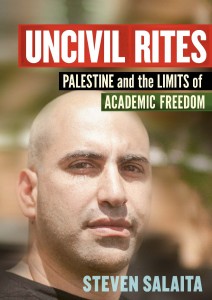
A review of Steven Salaita’s book – Uncivil Rites: Palestine and the Limits of Academic Freedom, published by Haymarket books, Chicago, Illinois, 243 pp.

Jake Lynch

uncivilrights.cvr_.2Uncivil Rites is an uplifting, uneven, fizzing celebration of the struggle for humanity in the face of an unholy alliance between Zionism, the hostile corporate takeover of scholarly communities that has corrupted University administration, and the militarism that seeks to quell resistance to injustice. By turns angry, funny, maudlin, defensive, militant and ultimately affirmatory, the book never lapses into either of the two signature modes that pro-Israel propaganda shares with ethnocentric American ‘patriotism’, namely rage and hate.

Salaita was born in West Virginia to a Jordanian father, and married into a Palestinian family. At the outset of the book, he remarks on the subject of his PhD thesis, “on interrelated discourses of colonization in North America and Palestine” (p. 1). In 2013, he was appointed to a Professorial post in the American Indian Studies Program at the University of Illinois at Urbana-Champaign (UIUC) – only to have it withdrawn, the following year and before taking up the position, at the behest of the institution’s Board of Trustees. He was forced to establish this in court, as the University tried to deny that he’d ever been offered employment – just one of a stunning array of dirty tricks played upon him in a campaign of “Zionist repression” (p. 53).

Salaita’s ostensible “crime” was a series of tweets, sent from his personal Twitter account, critical of Israel’s so-called “Operation Protective Edge”, the attack on Gaza in mid-2014 in which over 2,000 civilians were killed. One said: “I wish all the fucking West Bank settlers would go missing” (p. 10). As he observes, the word, “missing” acquired a particular resonance in Israel at the time as it was used to refer to three teenaged boys from a settlement in Gush Etzion, in the occupied Palestinian West Bank, who were kidnapped from a hitch-hiking stop and whose bodies were later found in a field near Hebron.

As Salaita recalls, “the Israeli government immediately blamed Hamas, which turned out not to be responsible, and facilitated one of the worst outbreaks of mob violence in recent Israeli history” (p 10). His ‘offending’ tweet came a week into this cynically engineered bout of nationalistic hysteria.

The murder of the three boys was an infamous crime, but there was – and remains – something obscene about the disproportionate political and media attention the incident generated, when the far greater number of young Palestinian lives destroyed or blighted by the occupation, its appurtenances and cruelties are met typically with comparative indifference. The former stood out as an aberration from a norm; the latter is the everyday grinding reality for a dispossessed people.

In Salaita’s own words, “I thought it a suitable moment to reflect on a fundamental Palestinian desire to end military occupation. I invoked the ‘go missing’ phrase because of its currency in that moment. I didn’t mean kidnap or murder”. But the tweet was to return to haunt him as it was one of those cited by the “sub-mediocre sycophants” (p. 195) who populate upper University administrative corridors as an excuse to ride roughshod over UIUC’s own rules, and the integrity of its American Indian Studies program, and fire him.

The ‘offence’ his tweets are supposed to have caused has to be seen in context. ‘Protective Edge’ saw Israel isolated in world public, media and political opinion as seldom before. It leant further impetus to the Boycott, Divestment and Sanctions movement, which was by then identified by authorities in Israel as a strategic threat. We now know, thanks to a report by the United Nations Conference on Trade and Development, that foreign direct investment in Israel halved in 2014, with one of its co-authors, Israeli economist Dr Ronny Manos, attributing the sharp drop to fallout from the military onslaught on Gaza and “international boycotts” against Israel for “alleged violations of international law.”

Salaita’s “vocal support” for the academic boycott, a key component of BDS, tops his own list of “factors that contributed to my firing” (p. 48). As he remarks, BDS puts the wind up the parasitic class of corporate-friendly administrators now wrecking universities throughout the neo- liberal world, not merely for its Palestine advocacy but because it represents “grassroots organizing, faculty autonomy, antiracism, decolonization, systemic critique” (p. 56) – all supposedly prerogatives of academic freedom that somehow feel embarrassing in attempts to cosy up to rich donors.

There is also something intrinsically disobliging about Palestine advocacy to a still-dominant American narrative that waxes choleric when reminded of the genocidal war against the continent’s first nations that was a condition of its founding. “Palestine… is an anxiety, one whose existence ensures the survival of the American Indian” (p. 100). US support for Zionism is tendered “for reasons that eclipse geopolitics” (p. 100).

Similar observations could be made about Australia, which suppresses its Aboriginal population with ever-intensifying bureaucratic zeal, and where my own prominent advocacy of the academic boycott has given me a taste of the treatment meted out to Salaita. The “consummate disingenuity” (p. 123) that leads critics of Israeli government policies to be smeared as “antisemitic” is one experience we share. As is the Orwellian use by University managers of the word, “civility” to shut down dissension from an approved spectrum of views and modes of expression when tackling divisive issues on campus.

Earlier this year, University of Sydney management disgracefully connived in a libellous campaign against me by a hasbara organisation, the “Australasian Union of Jewish Students”, and instrumentalised the resulting hysteria to institute disciplinary proceedings, after a speech by a notorious apologist for Israeli militarism was interrupted by a noisy student demonstration. My “crime” was to intercede to prevent security guards from manhandling protesters in ways assessed by a senior medical practitioner as potentially highly dangerous.

In common with other campuses, including many in the US, the scholarly community includes many who profess to be ‘progressive except on Palestine’, and many more who keep their heads down or occasionally pop up to parrot management idiocies. But there are also a few doughty fighters for freedom and for human values in the governance of public affairs in general, and solidarity with peoples in struggle for rights and freedoms, in particular.

In my own case, the campaign worked, and the University had to declare that the charge of antisemitism was refuted. Unlike Salaita, I managed to keep my job. As he notes, “the kindness and generosity of the uncivilized [is] stunning… if this is incivility, then I eagerly accept my confinement to the dignity of the uncivil” (pp. 62-63).

Uncivil Rites rambles at times, and has the feeling of picking at different threads in parallel. It was forged in struggle, which took its author on a nonstop speaking tour as word spread of the injustice done to him, and its implications – with portions of the book written in haste or in discomfort while waiting for planes or travelling on trains.

The public outcry at his treatment took the backstairs-crawlers at UIUC by surprise. As Salaita concludes, “Suppression relies on the anxiety of its targets. It is sustainable… only in relation to our quiescence” (p. 188). He goes on to set out a stage-by-stage plan for effective campus organising around the academic boycott and related issues. Uncivil Rites deserves to be read as a classic of the movement, and its author’s courage and integrity widely emulated.

Associate Professor Jake Lynch is Director of the Centre for Peace and Conflict Studies at the University of Sydney, and a member of Sydney Staff for BDS, which is affiliated to the Australia Palestine Advocacy Network.

Continue reading

Sydney University’s decision not to dismiss Jake Lynch highlights baselessness of the Israel lobby’s campaign against him

2015-05-14 13.15.37

Today’s announcement by Sydney University management that it will not be dismissing Jake Lynch highlights the vexatious and baseless nature of the Israel lobby’s campaign against him, Sydney Staff for BDS (SSBDS) said.

SSBDS welcomes management’s decision to end the disciplinary process against Lynch. It brings to an end a politically motivated two-month investigation, initiated in response to pressure on the university from pro-Israel forces.

The Israel lobby has long sought the scalps of pro-Palestine academics such as Lynch. “Peter Wertheim, Alex Ryvchin, Dean Sherr and other spokespeople for pro-Israel organisations cynically saw an opportunity to attack one of their ideological opponents,” said David Brophy from SSBDS. “The fact that the University of Sydney has rejected their allegations is a blow against Zionists’ intimidation of Palestine activism in Australia.”

This case must be set in the context of a worldwide upturn in the use of accusations of anti-Semitism to intimidate and silence pro-Palestine voices on campus. In the first four months of 2015, Palestine Solidarity Legal Support recorded 60 instances at US universities where criticism of Israel was met with accusations of anti-Semitism. This unscrupulous tactic of conflating criticism of the Israeli State with anti-Semitism has done great damage to the need to identify and combat genuine racial discrimination, including anti-Semitism, in society.

Claims that Palestine activists at Sydney are anti-Jewish have been the go-to argument of Lynch’s critics. After Sydney University responded to the allegations of anti-Semitism by launching an investigation, The Australasian Union of Jewish Students leapt into action by emailing its members a set of misrepresentations and fabrications, among them that Lynch “shouted in the faces of Jewish students” and that he “has a history of supporting harassment and discrimination against Jewish students.”

In addition it launched a petition for Lynch’s sacking, arguing that “anti-Semitic behaviour, harassment, and intimidation have no place in Australian society and they certainly have no place at the University of Sydney.” Even after the charge of anti-Semitism was found to be groundless, AUJS’s Julian Kowal maintained that Lynch had compromised the university as a “safe space for Jewish students”, for which he should be dismissed.

In this light, Dean Sherr’s recent claim that AUJS’ campaign against Lynch does not rest on a complaint of anti-Semitism stands exposed as a scandalous bid to rewrite the factual record.

Peter Wertheim has stated that “the charge of antisemitism is not levelled lightly,” but the barrage of irresponsible op-eds smearing as Lynch as anti-Semitic suggests otherwise. Under the headline “Antisemitism on Campus: Has Sydney University’s Jake Lynch Finally Gone Too Far?”, Glen Falkenstein included Lynch’s actions in a discussion of “anti-Zionism”, “which through its manifestations and rhetoric clearly can serve as a mask for blatant antisemitism.” In The Australian, Peter Baldwin continued along the same lines, saying: “My sense is that increasingly anti-Zionism is a mask for occulted anti-Semitism.” In recent weeks such insinuations have continued to flow freely from the pens of Lynch’s critics.

“The Israel lobby’s resort to these plainly baseless accusations highlights their lack of any real arguments against Palestine justice activists,” said David Brophy.

“These lobby organisations are dedicated to preventing a free and informed debate on the question of Israel/Palestine from occurring in Australian society. Sydney University should strive to ensure that such a debate can take place on campus by resisting these vexatious attacks. The institution’s commitment to academic freedom, which has been reiterated a number of times with reference to Lynch, requires that it do so.”

“We welcome the end of the proceedings against Lynch,” added Nick Riemer from SSBDS. “The University should be congratulating Jake for promoting the cause of a just peace in the Middle East, not threatening him with the sack for it. It’s now time for the University to drop all its charges against the student protesters too.”

Sydney Writers’ Festival: Reject Partnerships with Apartheid Israel

A Palestinian man inspects the damage to a library inside al-Eslah mosque after local witnesses said it was hit by an Israeli airstrike in Gaza November 18, 2006.  REUTERS/Mohammed Salem (GAZA) - RTR1JGJZ

Click here to add your name to this petition. 

To the organisers of the Sydney Writers’ Festival:

It has recently come to our attention that the festival has received support from the Israeli embassy for one of its panels (Assaf Gavron: The Wild West Bank). We have no objection to the author or his work, but rather to the institutional relationship that brings him to the festival. Sustaining a partnership with the Israeli embassy at this time serves to normalise and legitimate Israel’s many violations of international law and Palestinian human rights.

In 2008 an Israeli invitee to the festival revealed that Israel’s Ministry of Foreign Affairs offered funding for his visit to Sydney on the condition that he would “promote the policy interests of the State of Israel via culture and art, including contributing to creating a positive image for Israel.” Whether or not such contracts are still in use today, the purpose of Israeli sponsorship remains the same: to use culture to whitewash Israel’s image abroad.

This year’s festival theme asks the question “How to Live?” We reply: by avoiding complicity with historical and ongoing injustices, with practices of occupation, colonialism, and apartheid.

The people of Gaza are still struggling to recover from the bloody 51-day assault last year, which left over 2100 Palestinians – including around 500 children – dead, displaced a fourth of the population, and involved numerous potential war crimes. The world’s silence towards this atrocity has only emboldened Israel’s war camp: this month saw the election of an extreme right-wing government with ministers who have publicised calls for the genocide of the Palestinians.

While we in Sydney celebrate the pleasure of reading, Israel denies this same pleasure to the Palestinians. Along with schools and universities, the 2014 assault also destroyed two libraries in Gaza, and Israel’s blockade of the Palestinian territories regularly prevents shipments of books from reaching readers. The occupation also restricts the ability of Palestinian writers to travel abroad to festivals such as yours.

Since 2005, Palestinian civil society has called on people of conscience around the world to engage in a peaceful campaign of boycotting, divesting from, and sanctioning Israel in order to force it to comply with international law. The BDS movement has grown exponentially since then, attracting support from a range of cultural and literary figures around the globe, including Naomi Klein, Arundhati Roy, Cornell West, and John Pilger.

We appeal to the organisers of the Sydney Writers’ Festival to withdraw the current sponsorship arrangement with the Israeli embassy, and henceforth to refrain from collaboration with it. This is not, we emphasise, a call to isolate or boycott individual Israeli authors, but to renounce business as usual with the organs of a state that routinely violates international law and basic human rights with impunity.

As was the case in South Africa, where international solidarity played a crucial role in bringing down apartheid by boycotting the economic, sports and cultural institutions of the apartheid regime, we request that you not partner in any capacity with the Israeli government and other complicit institutions, until Israel fulfils its obligations under international law and recognises the Palestinian people’s right to live in full equality and freedom in their homeland.

This attack is wrong, it is cowardly, it is corrupt. It must not be tolerated.

civil libs mtg 2

A speech delivered to the April 29 campus meeting opposing the disciplinary action being taken by the University of Sydney against SSBDS member Jake Lynch and five students, all advocates of Palestinian human rights.

I acknowledge that we’re meeting on Aboriginal land.

I’d like to put our current agonies in context by asking what the value of dissent is in a university.

Some people have expressed disbelief that freedom of speech could be invoked to defend the students’ protest against Richard Kemp. They’ve denounced what they call our “perversion” of that concept.

Our critics, including the Vice Chancellor, have made it clear what forms of dissent they’re prepared to tolerate. Only speak when it’s your turn; don’t raise your voice; always be tolerant of others – unless, of course, you’re the Vice-Chancellor himself, when you get to threaten people with the sack if you find their views hard to bear.

Protest, interruption and dissent are what democracy looks like. That’s not an empty slogan: it’s the fact of the matter. We can’t allow academic decorum to paralyse us so rigidly that we’re prevented from turning our heads to face the lesson of history: it’s the young activist with her megaphone, not the intellectual in their seminar room, who leads the struggle for a better world.

Students routinely interrupt speakers on university campuses. In threatening them with disciplinary action, the leaders of this university obediently do their bit to legitimize and reinforce one of the most dangerous features of modern societies – the criminalization of dissent. This is the opposite of the civic purpose a university should fulfil.

Today we’re told what an intolerant, disrespectful, uncivil thing it was to interrupt Richard Kemp – Richard Kemp, who brags of the humanity of the army that littered Gaza with over 2000 Palestinian corpses less than a year ago.

I wonder what they’ll tell us tomorrow, or the day after. Perhaps that it’s disrespectful to hold a political meeting? They’ve already banned a meeting on Anzac day and militarism.

Or perhaps that it disturbs people to hand them a political leaflet on their way into university.

Or maybe they’ll tell us that we can’t be too critical of politicians at conferences, or in our tweets.

Is this irresponsible hyperbole? It’s a matter of public record that these kinds of censorship are already happening at our university. Our current Chancellor is from QBE Insurance. Who’s to say our next one won’t be from SBS?

Yesterday, the Vice-Chancellor posted an article on Yammer by the Human Rights commissioner, Tim Wilson, defending the sacking of Scott McIntyre for expressing his political views. The VC said the article was “interesting”.

So, who here is really on the side of free speech? Those of us defending protest and dissent, or those who demand the scalps of staff for their political views and who support dragging them and students through an inquisitorial legal investigation?

Free speech can’t be invoked to quarantine power from its critics and to doubly silence the voiceless. Disruption is what protest is for. Another name for it is “speaking truth to power”. Suppressing it in the name of civility is to substitute etiquette for the real battle of ideas.

And what about Jake in all this?

Education should be directed to the liberation of human capacities. Academics aren’t just obliged to conduct free enquiry and disseminate its results; we also have a duty to maximize the opportunity for others to do the same.

In advocating justice for Palestine, Jake’s intention has been to do exactly that.

Now, he is facing the sack for his principled expression of a conscientious and nonviolent educational politics. A more serious affront to the university’s purpose couldn’t be envisaged.

Teaching and research are already heavily shackled by inequalities of class, gender and race – as Palestinian academics and students know only too well. They must not also be subject to the politically-motivated interference of university administrations.

It’s not a coincidence that this attack is being made against a BDS exponent. It’s precisely the controversial views which the principles of intellectual and political freedom are needed to protect.

What’s being done to Jake is an attack on every student and academic here, whatever their views on Palestine and BDS. It’s wrong; it’s cowardly; it’s corrupt; it must not be tolerated.

Defending Jake and the protesters is incumbent on everyone who thinks dissent matters.

Universities should be places where people stand up to power, not where they are docile and compliant before it. Otherwise we’re consenting to the servile debasing of education for political gratification, and professing the creation and reproduction not of knowledge but of propaganda.

Nick Riemer

Speak-out: End Sydney Uni’s Exchange with Israeli Apartheid

Time: Monday 20 April, 1pm

Location: Eastern Avenue, University of Sydney

This coming Monday, Sydney University will hold its Sydney Abroad Fair, where members of the “Australian Friends of Hebrew University of Jerusalem” will be promoting Israel as a study abroad destination.

Our official relationship with Hebrew University of Jerusalem (HUJ) confers legitimacy and prestige on an institution globally recognised as a violator of Palestinian human rights.

HUJ has direct links with the Israeli State, contributing to its military programme, actively participating in the illegal occupation of Palestinian land, and denying rights to Palestinian students.

In 2014 HUJ gave full public support to the assault in Gaza that killed more than 2,200 people, including more than 500 children.

It has expanded its Mount Scopus campus onto land illegally confiscated from Palestinians in East Jerusalem.

HUJ allows admission to few Palestinian students, and those that it does admit have their freedom of speech and right to protest restricted.

HUJ’s record is no secret and academic institutions internationally are beginning to act. Last month staff and students at London’s prestigious School of Oriental and African Studies voted overwhelmingly to cut all official ties with HUJ.

It’s time that Sydney University did the same.

Join us at 1pm on Eastern Avenue to speakout against Sydney University’s exchange partnership with Hebrew University, and to call on our institution to cut all ties with Israeli apartheid.

Members of Sydney Staff for BDS will be leafletting at the Sydney Abroad Fair from 11am onwards. Please get in touch if you’d like to help out!

Israeli soldiers arrest a Palestinian protester during a Palestinian protest at Hebrew University in Jerusalem,