Sydney Staff for Palestine express our unconditional horror at Sunday’s antisemitic attack at Bondi. We extend our deepest condolences to all those bereaved and grieving as a result of these crimes. We express our particular solidarity with all our Jewish colleagues, and to everyone traumatized by the events at Bondi, whatever their background or religion.
Our group was formed by Palestinian, Jewish, and other members of staff in response to the genocide unfolding in Palestine, to advocate non-violent tactics such as BDS. In that context, we note again the impossibility of combatting antisemitism without simultaneously fighting all forms of racism. Alongside our horror at Sunday’s gratuitous and criminal loss of life, we are deeply troubled at the prospect of heightened repression of civil liberties, and an anti-Palestinian and Islamophobic backlash.
We also note with alarm renewed calls to further erode freedom of speech and intellectual freedom at universities. Such restrictions have gone too far already. Astonishingly, the university’s current ‘lecture announcement’ policy prohibits academic staff from discussing Sunday’s attack in class. This is censorship pure and simple, as unjustified as it is counterproductive. Universities must be places where the most urgent issues of our society can be freely discussed.
Antisemitism, like all forms of racism, is abhorrent and has no place in our society or on our campus. We are committed to the struggle to stamp it out wherever it arises.
The University of Sydney’s decision to award an honorary doctorate to Vic Alhadeff and allow him to address the May 20 graduation ceremony represents a new low in the institution’s pandering to Israel and its defenders.
At a time when much of the Western establishment is reluctantly, and all-too-belatedly, waking up to Israel’s genocidal violence against the Palestinians, the morally bankrupt administrators of the University of Sydney have rolled out the red carpet for one of Israel’s most zealous public apologists.
In the eyes of the University of Sydney, Alhadeff’s track record is one of “lifelong contributions to civil society.” The truth is, Alhadeff’s lifelong dedication to the apartheid state of Israel has had a destructive impact on public life in Australia.
Far from “championing human rights,” Alhadeff has long opposed bodies such as Human Rights Watch for their criticisms of Israel. He has described the charge of apartheid, now levied against Israel by (among others) Human Rights Watch, Amnesty International, B’Tselem, and multiple UN Special Rapporteurs, as a “baseless slur”.
Alhadeff’s public writings consistently avoid mention of Israel’s occupation, the siege of Gaza, or the human suffering that Palestinians have endured. He has made it his mission to downplay Palestinian grievances and whitewash Israel’s crimes. Typical was his response to the 2008 war, in which more than 1,000 Palestinian civilians died. He claimed, nevertheless, that Israel’s intentions were “clearly to avoid harming civilians.”
University of Sydney Chancellor David Thodey claims that Alhadeff has spent his life “fostering community cohesion.” But the fact is, Alhadeff’s lobbying efforts have done serious damage to relations between the Muslim community and the NSW government.
During Israel’s 2014 war on Gaza, as chair of the NSW Community Relations Commission, Alhadeff justified Israel’s actions in an email circular which said, chillingly, that “all options are on the table.” He also circulated IDF propaganda claiming that Hamas were hiding in hospitals and ambulances—an all-too-familiar lie that now serves to justify the complete obliteration of Gaza’s hospitals and the assassination of paramedics.
In response to these divisive actions, Muslim representatives boycotted events with the NSW Premier. Alhadeff’s chairmanship of the Community Relations Commission was untenable and he had to resign.
Vic Alhadeff’s lobbying has extended to attacks on our own colleagues who have spoken up for the Palestinians. In 2015 the Jewish Board of Deputies, of which Alhadeff was CEO, participated in pressuring the university to fire Professor Jake Lynch. By awarding Alhadeff this degree, the University of Sydney has confirmed, yet again, that it has no desire to defend its staff from the specious attacks of pro-Israel lobbyists.
Given the timing, we cannot see this award as anything other than a deliberate gesture of support for the horrific genocide unfolding in Palestine today.
History will record that in the week when Israel’s determination to eradicate Palestinian life in Gaza became too much even for wilfully blind Western governments to ignore, the University of Sydney’s senior officers chose to double down on their solidarity with Jewish supremacism. Their dedication to this racist cause has come at the expense of all credibility on questions of human rights – for them, but sadly for our institution too. Rescinding this doctorate would only be the first step in a long path to claw that credibility back. Nevertheless, we call on them to take it.
University of SydneyNew Law School Lecture Theatre 106and online (registration details below)
In the escalating crisis, with Palestinians being made the objects of genocidal violence, and thousands already killed, the conflict in Gaza has been misrepresented and decontextualized. This in-person and online forum will hear from Palestinian, Jewish and other speakers expert in the history and context of the Gaza conflict and apartheid in Israel, and explain the importance of the Israel boycott campaign, including in universities.
Sydney Staff for BDS is delighted to host Somdeep Sen (Roskilde University, Denmark) for an online talk on his recent book Decolonizing Palestine: Hamas between the Anticolonial and the Postcolonial (Cornell University Press, 2020).
In Decolonizing Palestine, Somdeep Sen counters the notion that liberation from colonization exists as a singular moment in history when the colonizer is ousted by the colonized. Against the background of the past and present of Israel’s project of settler colonialism that rejects the existence of Palestine (and Palestinian-ness), he considers the case of the Palestinian struggle for liberation from this condition as a complex psychological and empirical mix of the colonial and the postcolonial. Specifically, he examines the two seemingly contradictory, yet coexistent, anticolonial and postcolonial modes of politics adopted by Hamas following the organization’s unexpected victory in the 2006 Palestinian Legislative Council election. Despite the expectations of experts, Hamas has persisted as both an armed resistance to Israeli settler colonial rule and as a governing body. Based on ethnographic material collected in the Gaza Strip, the West Bank, Israel, and Egypt, Decolonizing Palestine argues that the puzzle Hamas presents is not rooted in predicting the timing or process of its abandonment of either role. The challenge instead lies in explaining how and why it maintains both, and what this implies for the study of liberation movements and postcolonial studies more generally.
Somdeep Sen is Associate Professor in International Development Studies at Roskilde University, Denmark. His research focuses include settler colonialism with a particular focus on Israel-Palestine, urban politics in South Asia and the Middle East, race and racism in international relations, history of liberation movements and postcolonial studies. He is the author of Decolonizing Palestine: Hamas between the Anticolonial and the Postcolonial (Cornell University Press, 2020) and co-editor of Globalizing Collateral Language: From 9/11to Endless Wars (University of Georgia Press, 2021). His work has also appeared in Foreign Policy, The Washington Post, Al Jazeera English, The Huffington Post, Open Democracy, Jacobin, The London Review of Books, The Palestine Chronicle and The Disorder of Things.
A similar talk by Som was prevented from going ahead by Zionist pressure on the University of Glasgow (read the protest letter sent by the British Society for Middle Eastern Studies to Glasgow University here). It’s a pleasure and privilege to be able to host Som for Sydney University Staff for BDS.
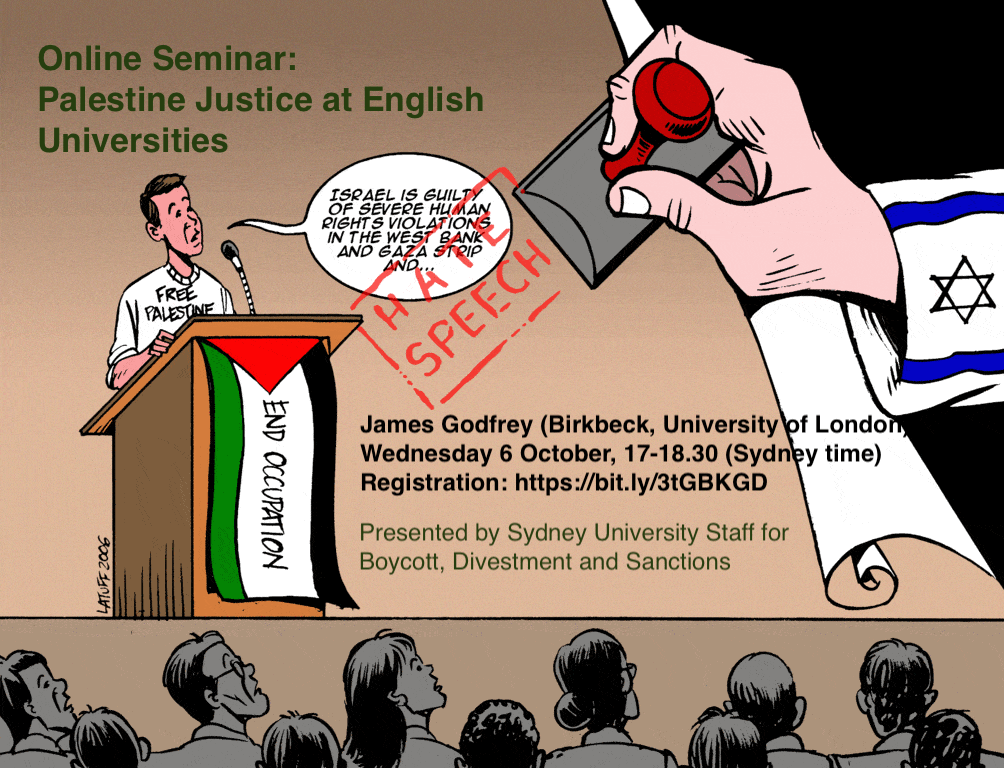
How is the Prevent duty in England – the UK government’s ‘anti-radicalisation’ scheme – affecting freedom of speech, research and campaigning about Palestine justice at English Universities? Drawing on his field research, James Godfrey will discuss the combination of pressures on students and staff at universities in England in relation to teaching, researching and campaigning about Palestine. Despite these pressures, he continues to observe students and staff resisting in various ways. What lessons can be learnt in Australia from these experiences and strategies?
James Godfrey is a postgraduate researcher in Law at Birkbeck, University of London, and a visitor at the ANU, investigating the ‘Prevent duty’ in the Counter Terrorism and Security Act 2015 and its impacts on campaigning and free speech re Israeli Occupied Palestine within universities in England. He has interviewed students, staff, staff of student organisations, members of Palestine solidarity organisations and Islamic Societies, and representatives from peak bodies. Since the 1980s, James has participated in organisations campaigning for social justice, locally and internationally, focussing since 2011 on justice for the Palestinian people. He is a spokesperson for the Freedom Flotilla Coalition, which physically challenges the illegal Israeli blockade of Gaza. James has also worked as a trade union organiser in Sydney and London.
The paper will look at the difficulty of teaching Palestine, in particular the Israel-Palestine conflict, in a range of classroom settings. Various myths about this conflict exist – its supposed complexity, its age-old status, its religiosity – that need to be addressed and dismantled before any headway can be made to reconfigure the terms we can use to engage with learning about this conflict in the classroom. This is not a unique to teaching Palestine, but when coupled with managing sensitivities and allegiances in the classroom can make for a challenging set of tutorials. Furthermore, the classroom in my experience in teaching this topic has been subject to external stakeholders who attempt to influence what is taught and what historical narrative is suitable. This paper will outline some of these challenges and ask what can be gleaned from such a fraught teaching situation.
Jumana Bayeh is a Senior Lecturer at Macquarie University. Her research focuses on the diaspora cultures of the Arab world, and literary and cultural representations of the riot in the Middle East and beyond. She teaches various units that focus on the politics and history of the Middle East, from the early twentieth century to the present. The seminar is presented by Sydney University Staff for BDS, a group of Sydney University staff members supporting the institutional academic boycott.
Saree Makdisi is Professor of English & Comparative Literature at the University of California, Los Angeles and a proponent of BDS, the campaign for justice for Palestinians through an end to Israeli apartheid. As well as his numerous works on literature and culture, Prof. Makdisi is author of Palestine Inside Out: An Everyday Occupation. In this talk he will discuss the politics of Palestine liberation in the context of his forthcoming book, Tolerance is a Graveyard. The seminar is presented by Sydney Staff for BDS, a group of Sydney University staff members supporting the institutional academic boycott of Israeli universities. Everyone is welcome.
A speech given to the Israeli Apartheid Week protest at Sydney University, March 17, 2021, by Khaled Ghannam, a Palestinian writer and activist living in Sydney.
It is sixteen years since the official foundation of the BDS movement in Palestine. The movement against Israeli apartheid has a long history and deep roots, but it was on 9 July 2005 that it was established formally.
Endorsed by Palestinian unions, political parties, professional associations, women’s groups, human rights organisations and religious and cultural associations, the BDS movement stands against Israeli’s violations of Palestinian rights. It is modelled on the successful movement to boycott apartheid in South Africa.
The Palestinian liberation struggle is most notable for its clarity and principles, for making a set of three clear demands [a lifting of the occupation of the West Bank and siege of Gaza; an end to discrimination against Palestinian citizens of Israel, and recognition of the right of return] and for its unifying effect on the Palestinian body politic.
The Israeli government must stop ignoring its international obligations as an occupying power and immediately act to ensure that COVID-19 vaccines are equally and fairly provided to Palestinians living under its occupation in the West Bank and the Gaza Strip, as demanded by Amnesty International.
The Israeli occupying authorities have implemented their vaccine policy in a discriminatory, unlawful, and racist manner by completely disregarding their obligations to Palestinian healthcare. Throughout the Occupied Palestinian Territory (OPT), apart from East Jerusalem, Israeli occupying authorities have reserved access to the vaccine to the population of Israelis unlawfully transferred in to the illegal settlements as settlers.
Furthermore, Israel’s occupation steals Palestinian Natural Resources like underground water and Natural Gas, and keeps digging on occupied land. Recently, the Israel Antiquities Authority discovered new Dead Sea Scroll pieces in a site named ‘The Cave of Horror’, which is located in southern Occupied Jerusalem. Israel has circumvented Palestinian self-rule, and may have circumvented a United Nations resolution that prohibited unearthing and removal of significant artifacts from occupied areas under foreign control.
We asked you and all academic bodies around the world to boycott Israeli academic bodies working on occupied Palestine.
The BDS movement has raised the awareness of the world that Palestinians are one people. They have a right to independence.
Join Sydney Staff for BDS and Students for Palestine Sydney University for a campus protest to mark Israeli Apartheid week 2021 at midday on Wednesday March 17, outside Fisher Library at the end of Eastern Avenue.
2021 Israeli Apartheid Week Global callout (https://bdsmovement.net/iaw)
Racism, discrimination, xenophobia, and inequality continue to grow around the world. In recent months, we have seen how people in the Global South and people of color, political prisoners, unhoused people, migrants, and refugees, among many others, have suffered from the scourge of COVID19, which has further exacerbated their vulnerability.
We have also seen how millions of people around the world have taken to the streets to protest against systemic racism, patriarchal violence, climate injustice, neoliberal austerity, and economic inequality, among other oppressions that continue to suffocate us. These protests for long-denied justice have inspired us to keep resisting injustice, to continue dreaming of freedom, and to keep insisting on our rights, in a united global front against racism and oppression.
Now, more than ever, we need you, we need each other. We need all our voices united across the world to end racism, colonialism, and apartheid.
Palestine remains a central testing ground for global repression. Israel’s apartheid regime tests its militaristic and racist ideologies, surveillance tools, and weapons of oppression and racial domination on Palestinian bodies and society for export to the world as “field-tested.” These tools end up aggravating the militarized and racial oppression in many countries around the world, from fortress Europe to the US, from India to Myanmar, from Brazil and Honduras to South Sudan and Rwanda, and far beyond. For the last 17 years, IAW has been organized around the globe to protest some of these injustices and to advocate for Palestinian freedom, justice, and equality as part of the struggle to attain our indivisible justice. Let’s continue to weave ever more powerful networks of hope and mutual, intersectional solidarity. Together we are unstoppable.